
Spin Overview
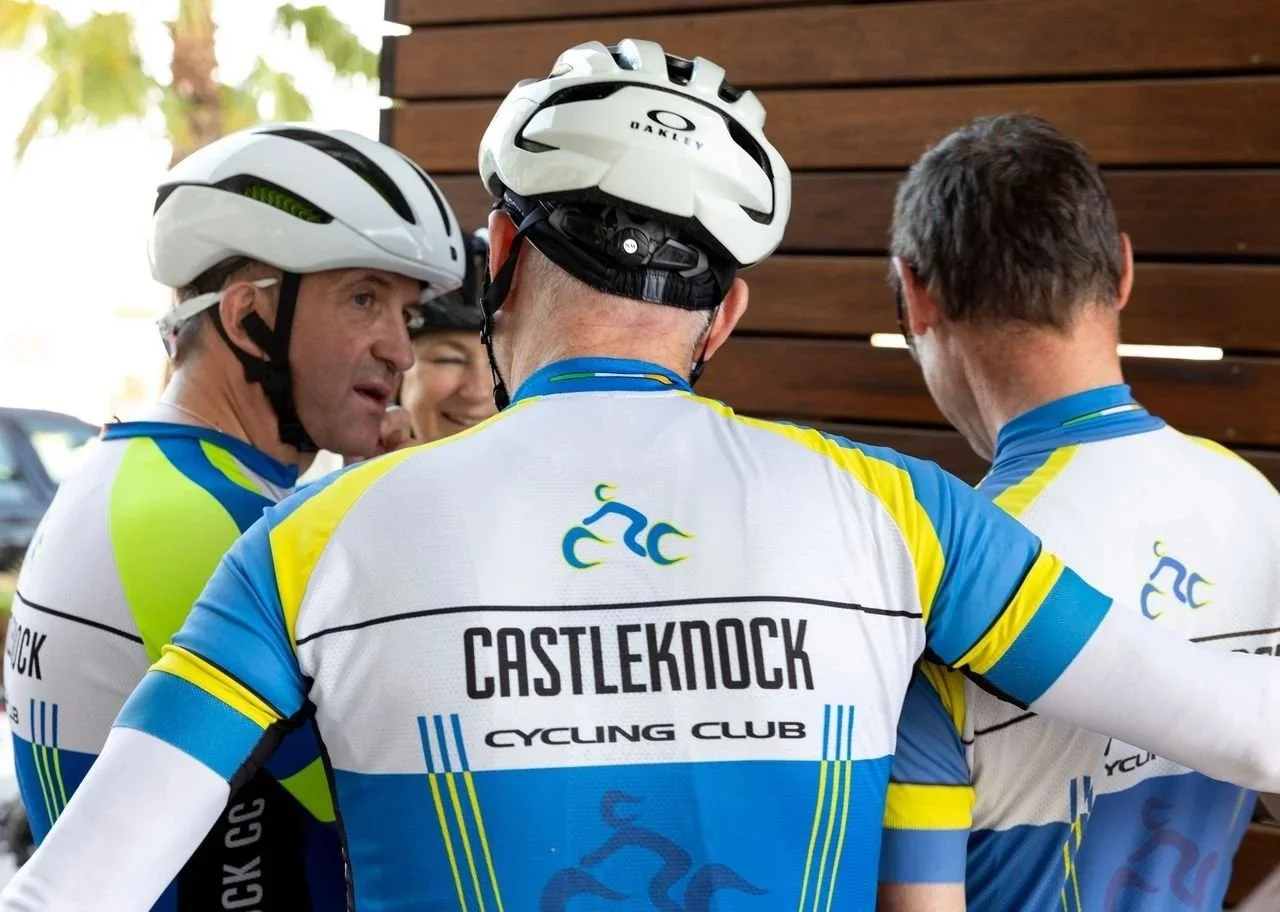
Castleknock Cycle Club runs organised weekly club spins on a year-round basis for its members (new members are welcome anytime). We have groups leaving from the gates of Castleknock Community College every Saturday and Sunday morning, normally rolling-out between 8:00am and 9:00am depending on the time of year.
Weekly spins are posted on our Club Strava page and leaders are assigned for each group. Members will be aware that on occasion we’ll exceed the indicative ranges, for instance on hilly spins to Wicklow, but all members will be aware of routes in advance of spin day.
Around the summer months (May-August), where daylight permits, we also run very popular midweek evening spins. These are shorter, faster spins, that make sure you forget about the working week for 90 minutes!
Categorised groups
Our Groups are categorised to allow cyclists of similar fitness & ability to enjoy and challenge themselves on our club spins. For more information on our spin categories, please visit the page; Cycling Groups
In general the spins tend to build up distance and climbing through the year, peaking around August/September, and tapering back after that.
Each weekend the various group head to the same general area, with the distance increasing as you go through the faster groups. This should allow everyone find a spin that suits them, but also presents the opportunity for anyone who may have overreached to drop back to a more relaxed group. We’ve all been there!
-
Each pace group (determined according to the average speed of the group to assist members to decide their comfort level according to fitness/ability) is assigned a designated 'spin leader'. The role of the spin leader is to provide leadership, know the route, and ensure the safety of everyone at all times. They are an experienced club member who are requested to keep an eye out for members who may be struggling, and will make calls requesting the group to stay together and to adjust their pace accordingly. They are responsible for pre spin briefings and checks.
Before The Spin
Know when you are assigned as Spin Leader (rota emailed weeks in advance and mid week
WhatsApp reminder)
Sign up on Strava as soon as rides posted
Know the route - load it on your Garmin but know the route
Check for any guests (Registrar will advise on WhatsApp)
Check the weather forecast
Check your bike is in good shape and you have right gear for route and conditions
Confirm ICE details accessible if required
On The Morning of The Spin
Introduce yourself as the Spin Leader
Advise route, distance, expected pace and check riders have appropriate gear, food, nutrition
Ensure group is manageable - ideally no more than 12 per group
If more than 12 split the group and enlist help of 2nd Spin Leader
Check for guests and if their bike & equipment is appropriate
Check for mudguards & lights if in the winter months
Remind everyone to "call the hazards", communicate loud and often
After the spin
Ensure everyone home safely
Enjoy a coffee and a cake
Get feedback from riders on spin - pace, route, conditions etc.
Post your Spin Leader report on the Spin Leader WhatsApp
-
Mandatory Requirements for All Club Spins
To ensure everyone has a safe, enjoyable, and smooth ride, we ask all members to follow these mandatory requirements for every club spin:
Sign Up in Advance: Please register for the spin on Strava or the designated platform the night before. This helps us plan and keep track of everyone.
Wear a Helmet: Safety first! A properly fitting helmet is compulsory for all riders.
Bring Your Bike in Good Working Order: Make sure your bike is well-maintained and ready to ride. This includes checking brakes, gears, and tyres before the spin.
Carry Essential Kit: At minimum, bring a spare tube, tyre levers, a pump or CO2 inflator, and a multitool. Being prepared means less disruption for you and the group.
Have Adequate Hydration and Nutrition: Bring enough water and some snacks or energy gels, especially for longer rides.
Follow Group Riding Etiquette: Ride predictably, signal clearly, and respect others on the road and in the group.
Be Punctual: Arrive on time so we can start together and enjoy the ride as a group.
Respect the Route and Spin Leader: Stick to the planned route and listen to the spin leader’s instructions for everyone’s safety.
By following these simple but important rules, we can all enjoy our rides safely and make the most of our time together. Thanks for being a great part of the club!
Saddle Bag Essentials
Essential Bike Toolkit Items & Their Importance
Spare Inner Tube (with Correct Valve Length)
Why: Punctures are one of the most common roadside issues. A spare tube is the quickest and most reliable fix.
Benefit: Allows you to swap out a damaged tube in minutes and get back on the road.Tip: Make sure the valve length matches your wheel's rim depth (especially for deep-section wheels). If unsure, go slightly longer.Valve Extension
Why: Needed if your spare tube’s valve is too short for deep-section rims.
Benefit: Ensures you can inflate the tube properly even with aero wheels.Tip: Carry one even if your spare tube has a long valve – it’s a great backup.Valve Core Tool
Why: Useful for installing or removing valve extensions and cores.
Benefit: Enables you to properly secure or replace valves on the go, reducing air leaks or valve-related issues.Mini Pump or CO₂ Inflator
Why: Essential for reinflating a tire after a flat.
Benefit: A pump offers unlimited inflation (though slower); CO₂ is fast and convenient, but single-use.Tip: Carry both if you can – pump as a backup in case you run out of CO₂.Tire Levers
Why: Help remove tight tires from rims without damaging them.
Benefit: Makes it easier and faster to change a tube, especially on the roadside with cold hands.Multi-tool (with Allen keys, screwdriver, and ideally a chain breaker)
Why: Covers a wide range of minor mechanical adjustments and fixes.
Benefit: From tightening a loose saddle to adjusting gears, this is your all-in-one roadside repair kit.Tip: Look for one that includes a chain breaker and spoke wrench.Spare Chain Link (Quick Link)
Why: A broken chain is rare but can end a ride without a fix.
Benefit: Allows you to reconnect a chain quickly and continue riding.Tip: Ensure compatibility with your chain speed (e.g., 10, 11, or 12-speed).Zip Ties
Why: Extremely versatile – can temporarily fix a broken bottle cage, loose cable, or even secure a saddlebag.
Benefit: Lightweight and space-efficient with a wide range of emergency uses.Patch Kit
Why: Backup for multiple punctures when you’ve used your spare tube.
Benefit: Lets you continue the ride if you get another flat.Tip: Glueless patches are convenient but carry traditional patches and glue for reliability.Cash or a Contactless Payment Card
Why: Useful for emergency coffee, shop visits, or even a taxi.
Benefit: Adds flexibility and security if plans go sideways.Small First Aid Item (e.g., plaster or antiseptic wipe)
Why: For treating minor scrapes or cuts.
Benefit: Gives you the ability to clean and cover a wound immediately.Emergency Derailleur Hanger (for more advanced riders)
Why: A snapped hanger is more common than you think and can end your ride.
Benefit: Some are universal and can help get your bike rolling again.Tip: Carry only if you're confident in replacing it roadside.Final Tips
Weight & Space: Choose compact and lightweight tools that won’t weigh down your saddle bag or jersey pocket.Practice: Know how to use everything in your kit before you need it.Group Awareness: Encourage everyone in the club to carry their own essentials. Shared gear is helpful, but self-sufficiency is key, especially on long spins or remote routes
-
Click on this link to view the Cycling Ireland guide to road cycling. The different sections, cover keeping your bicycle roadworthy, wearing proper equipment and cycling safely and considerately. It also includes guidance on cycling in groups, and suggested calls and hand-signals.
When riding either solo or in a group it is essential to respect certain rules, both for your safety and the safety of others – that includes all road users.
Some other unwritten rules for Group Cycling you need to make sure you are aware of:
It is important to be on time for club spins, be there 10 minutes before start time.
You are responsible for the safety of everyone around you as you are for your own well-being.
Be aware that everything you do has a knock-on effect on everyone behind and beside you.
Obey the rules of the road at all times – This includes NOT BREAKING RED LIGHTS and ensuring that the group is in the correct lane.
Group rides in two abreast formation – we are entitled to ride two abreast. Never take up more of the road than is needed and never cross the middle lines. Keep the group tight and stay together.
The frequency of groups rotation depends on the size of group, weather, pace etc. Group leader will often signal when to move up.
When you come through for your turn do so smoothly and close to the rider you are taking over from. Rider on inside should ease the pace slightly to let other rider through.
Don’t half-wheel – when you come to the front of the group, keep the pace consistent and match to your riding partner.
Avoid freewheeling at the front, this causes riders behind to bunch up & clip wheels.
Follow the wheels and don’t let gaps open when the formation is changing.
If you are struggling to close a gap, wave the rider behind you through.
Do your fair share of work at the front. If you are tiring, stay back rather than disrupt the rhythm of those who are working.
Signal that you are last man in the group, or if you are sitting-on/missing a turn.
When you hit a hill, maintain your effort level, not your speed.
When climbing hills, avoid following a wheel to closely. Many riders lose their momentum when rising out of the saddle which causes sudden deceleration.
For weaker riders on climbs, try to start near front and drop back through group.
Take/replace a bottle without having to look down so you keep a straight line.
Mistakes happen when cyclists are tired and under pressure. So if you’re getting tired then you are better sitting on the back of the group.
When someone has a puncture, mechanical or falls back on a climb, continue on at the same effort and turn around when safe, picking up your colleagues and continue on your original route. Make everyone aware of this before heading out.
Always carry the tubes, pumps, food and tools you need to look after yourself and your bike.
Lights should be used day and night during the winter months for your safety
Respect other cyclists by using at least a rear mudguard during winter training spins.
If someone is repeatedly making mistakes, tell them discreetly towards the end of the ride. If it’s you being given constructive criticism then try to learn from it.
Anticipate hazards and vigilance in relation to dangers of close overtaking manoeuvres by vehicles on the road
Bringing a phone is always a good idea you never know when you might need it – however mobile phones should not be used whilst riding in the group.
Stereo headphones should not be used on any group rides.
Aero-bars should not be used on group spins, as they make it unsafe.
Clean your bike – It prolongs drive-train wear and reduces the likelihood of mechanical problems.
-
We’ve put together the following guide to commonly used calls. We’ve also included a description of hand-signals where appropriate. You’ll be familiar with most of these already, but in case you need a reference, read on…
It is very important that all riders through the group repeat any calls made. Many calls start at front of group and it is important that all cyclists through group repeat the calls as those at middle and back of group are unlikely to hear the call of front riders. This works equally from back-to-front.
Some of the Cycling Ireland calls may be a little different to those used by CCC. If there’s any confusion or conflict, the CCC calls detailed above are the official CCC calls and should be used.
All-on
Question asked by riders toward front of group to confirm all riders in group are together, usually following a junction or a drag/hill. Should be answered by riders near back of group with “All On – Yes” or “All On – No” as appropriate.
Car-down
Used to indicate a car approaching from the front of the group travelling in other direction.
Car-up
Used to indicate a car approaching and overtaking group from the back of the group and travelling in the same direction.
Change
Used to indicate time to rotate riders at front of group; on this call rider on inside (left) at front should ease off slightly to allow rider on outside (right) to come across and take up position on inside; all riders on right of group should move up as appropriate. Call the “change ups” being mindful that everyone has an equal turn and is not on the front for too long. Keep the change ups shorter in windy conditions. Keep an eye out for weaker riders on the day who may be struggling, and ensure they are called into the ‘armchair’ and not kept on the front, so every effort is made to keep the group together. Stronger riders may wish to lead at the front when appropriate to do so, with the agreement of the spin leader. This assists in adverse conditions, or when riders may be tired at the end of a longer spin.
Clear
Used at a roundabout or junction to indicate to those behind that it is safe to proceed (e.g. no traffic coming).
Moving Out
Used to indicate group should move out to centre of road usually to pass / avoid an obstacle or other road user e.g. walkers; parked car, etc. Helpful to call out object e.g. “moving out – parked car”; “moving out – jogger”
Hand signal: put arm behind your back and wave in direction of moving.
Notch
Used to indicate to riders at front of group to slow down to allow a split group to reform e.g. if one or more riders got detached due to a junction or incline.
Ramp
Used to indicate a ramp ahead in the road.
Hand signal: extend arm up and down to indicate ramp
Roundabouts
At Roundabouts the call should be made in advance of roundabout indicating which exit the group is to exit e.g. “2nd exit; 3rd exit”. Otherwise and well in advance of roundabout, call “straight through roundabout”; “left at roundabout” or “right at roundabout” as appropriate.
Where more than one lane at roundabout Group should occupy lane appropriate for how exiting (i.e. as if driving a car) – left lane for left turn or straight through; right lane for right turn.
Shore
Used to indicate a manhole cover or similar hazard in the road; usually accompanied by location of hazard e.g. “shore left” to indicate by kerb/ditch; “shore centre” if in middle between riders; “short right” if to right of riders.
Hand-signal: extend arm and point toward direction of hazard
Single File
Used to indicate to group to file out into single file, usually if road is narrow, and to allow oncoming traffic pass safely or to allow traffic from behind pass if it has built up (NB: this call is to be used only rarely as it is nearly always safer for group to ride 2 abreast and for cars to wait for a safe opportunity to pass).
Slowing
No explanation needed; usually used when approaching a junction, roundabout or obstruction on the road; begin to slow and be prepared to stop if required.
Hand signal: extend arm and move up and down
Standing
To indicate rider is going to get out of saddle and “stand” on pedals; usually used when climbing and leads to a temporary slow down of rider as they transition from seating to standing.
Stopping
Again clear what this means; used when stopping at STOP sign, lights or stopping for any other reason.
Hand signal: extend straight arm upward, palm open.
Surface
Used to incidate a rough or uneven patch of road or other similar hazard (e.g. chippings); again usual to indicate direction e.g. “surface left”; “surface cnetre”; surface right”
Hand signal: extend arm in direction of hazard and move hand from side to side / up and down to indicate uneven surface